
Problem Addressed
As a generally less engaged segment of the population, we were interested in testing out online mechanisms to engage migrant populations ahead of the 2025 local elections.
From March to April 2025 we worked with a civil society organisation focused on migrant empowerment on two Facebook ad campaigns. One of them observed the performance of a register to vote call for the immigrant population in English, compared to identical messages in a voter’s own language. The second one tested an immigration framing about the upcoming election against a civic duty framing.
Approach & Implementation
Foreign Language Voter Registration Ads
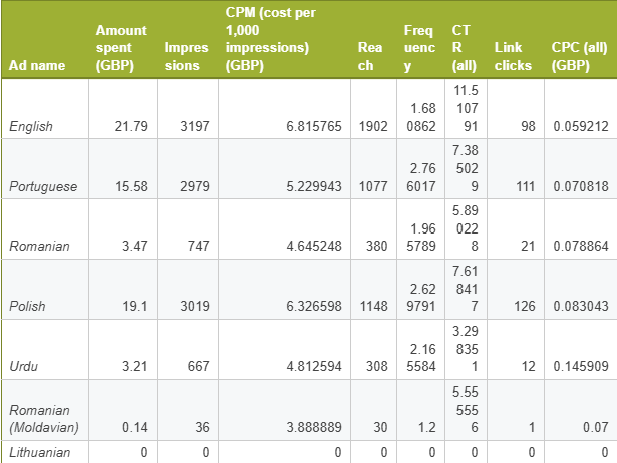
We first began with an ad campaign consisting of voter registration videos that ran throughout March on Facebook and Instagram as ads on the organisation’s page. The message of the video referred to the importance of immigrant voters to have their voice heard and then prompted people to register to vote. The video was recorded in 7 languages: English, Portuguese, Romanian, Polish, Urdu, Romanian (Moldavian dialect), Lithuanian, all of them having the same script but being recorded by different people, in their native language.
All of these ads were targeted to users in the local area speaking each respective language (e.g. English version to English speakers, Polish version to Polish speakers) using the Facebook internal targeting tool.
Immigration vs Civic Duty Framing A/B Test
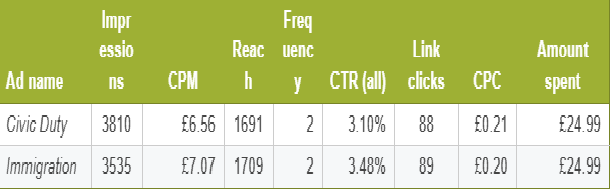
To further test messaging strategies when addressing immigrant populations, we have run an A/B test using Facebook’s internal testing tool. The ads ran from mid-April up until the election and tested 2 video versions of a GOTV message aimed at immigrants in the city.
The first framing focuses on voting in the local elections as a civic duty for all residents in the area, emphasising the need for local voices in how local decisions are made. The second framing characterises voting as a duty directly serving the immigrant communities.
The ads were targeted at only the migrant population in local area, through Facebook’s targeting tool by language spoken, to the following languages: Italian, Norwegian (bokmal), Dutch, Polish, Portuguese (Brazil), Russian, Swedish, Turkish, Czech, Spanish, Arabic, Hungarian, Portuguese (Portugal), Romanian, Slovak, Slovenian, Bulgarian, Croatian, Greek, Danish, Lithuanian, French (Canada), Punjabi, German, Ukrainian, Estonian, Spanish (Spain), Latvian, Finnish, Norwegian (nynorsk), Albanian, French (France) and Urdu.
Evidence & Evaluation
In the first ad campaign on foreign language voter registration ads, bar from the Lithuanian version, which did not reach any users (perhaps to the limited pool of Lithuanian-speakers in the area), the ads performed well. The English version performed best on metrics such as impressions, reach and click-thru-rate, closely followed by the Polish version and the Portuguese version. This would indicate that videos in a voter’s own native language are an effective way of engaging them when it comes to political content.
When carrying out the subsequent A/B test, however, Facebook did not find any difference between the civic duty message framing and the immigration one. Neither of the two ads performed too well, especially in comparison to the foreign language ones.
Conclusions and Recommendations
The two analyses together indicate that language might be an important factor to consider when creating political ads for migrant populations. Videos about local politics in a foreign language might surprise the audience, since it is rather rare to hear about British politics in a language other than English and, perhaps, even more pleasant in your own native language.
On the other hand, the framing of GOTV appeals in English, when targeted at migrants, does not seem to matter, as in both the civic duty and the immigration framing it was unlikely for the audience to engage at all. Perhaps the two frames would have worked better in the user’s native language instead, but more robust testing needs to take place on this language use before any strong conclusions can be drawn.
Overall, better targeting in non-partisan political ads might be needed for the message to reach broader audiences and to convince them and the use of foreign languages seems to be a good avenue to explore further.
We’d love to hear your thoughts on our test. Your feedback is essential to improving our work, so if you have any comments or suggestions, please get in touch at [email protected]