
Problem Addressed
This pilot study explored whether living next to visible campaign materials, specifically garden stakes, affect voter turnout during elections. The underlying hypothesis was that visible signs of community political support might influence civic behaviour by fostering social norms around participation, signalling local engagement, or encouraging individuals to vote when they see that others nearby are politically active.
Approach & Implementation
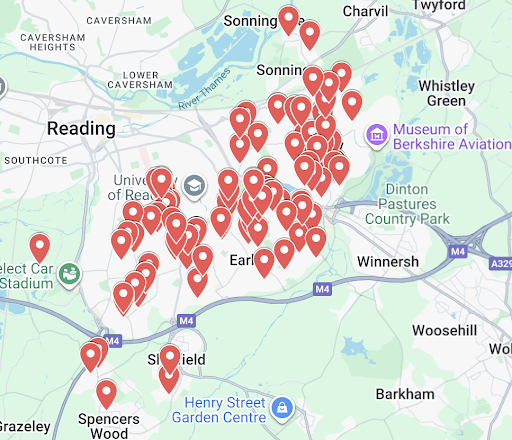
A total of 112 garden stakes were distributed to residents who volunteered to display them in the towns of Earley and Woodley. Although not randomly assigned, these stakes were mapped to voter data from the 2024 General Election marked register, which records whether individuals voted. Each voter was matched by postcode to determine whether they lived near a displayed stake. If at least one household in a postcode displayed a stake, all residents within that postcode were coded as being in proximity to one.
The dataset included 67,481 voters, of whom 5,448 lived in postcodes with at least one stake present. Turnout among those exposed to the stakes was compared with those who were not, both descriptively and through regression analysis to test for statistical significance.
Evidence & Evaluation
The analysis found no measurable relationship between the living in the presence of garden stakes and voter turnout. Turnout levels were broadly similar between those living near stakes and those who were not, and regression results confirmed that any differences were statistically insignificant (p > 0.05).
Several limitations qualify these results. Because the stakes were distributed voluntarily to party-friendly residents, they were concentrated in areas with pre-existing high political engagement, limiting causal inference. In addition, proximity was defined by postcode, meaning not all residents coded as “exposed” necessarily saw a stake. The analysis also focused solely on turnout, not vote choice, so potential effects on partisan preference could not be assessed.
Overall, the study provides no evidence that residing next to a garden stake increases voter participation. While such displays may have symbolic or morale-boosting value, the findings suggest that campaign resources would be better allocated to strategies with stronger demonstrated impacts on turnout, such as door-to-door canvassing, personalised contact, and hyperlocal engagement.
We’d love to hear your thoughts on our test. Your feedback is essential to improving our work, so if you have any comments or suggestions, please get in touch at [email protected]