
Executive Summary
This report details the findings of a Randomized Controlled Trial (RCT) conducted during the Leamington Clarendon local by-election. The study sought to test whether presenting Labour-likely voters with specific, ward-level local issues (such as pothole repairs and planning permissions) would increase voter turnout.
Despite a small-scale yet well-executed deployment, the intervention yielded no statistically significant impact on voter behavior. The turnout rates between the treatment and control groups were virtually identical, suggesting that the tested postcard intervention, in its current form, does not drive increased participation.
Background and Strategic Objectives
Local by-elections serve as vital “controlled environments” for testing campaign tactics with minimal resource demands. Campaign Lab’s objective is to establish a standardized “cookie-cutter” testing approach. By pooling data from multiple small-scale tests, the organization aims to create meta-analyses that transform localized experiments into robust, generalizable campaign strategies.
The Intervention
The experiment tested a “Local Focus on Party Issues” hypothesis. It was theorized that voters would be more motivated to participate if they saw a direct connection between their vote and the resolution of hyper-local issues.
- Treatment: A postcard mailer focusing on three specific local election promises (e.g., fixing a major pothole, managing a new shopping complex proposal, and addressing river pollution).
- Medium: Postcards were chosen to minimize costs and maximize “contact” by removing the barrier of opening an envelope.
Methodology & Implementation
The trial was designed as a collaborative effort between Campaign Lab and the local partner campaign. The leaflets were designed by Campaign Lab in partnership with the participating partner campaign and funded with a donation from a Labour Party donor.
The participating partner campaign provided a list of Labour-likely voters in the area; treatment and control groups were randomly selected from this list. The treatment group received a leaflet by mail in the week before the election day, whilst the control group received nothing. Once the election was concluded the partner campaign secured the marked register for the election which was digitised and data captured using Labour Scan. The resulting csv file was then analysed using R to assess the impact of the leaflet on voter turnout amongst the “Labour-likely” voters in the treatment group relative to the control group.
| Responsible Party | Key Tasks |
| Partner Campaign | Provide local issue context, approve leaflet copy, and provide Labour-likely voter lists from Contact Creator. |
| Campaign Lab | Design, print, and distribute mailers; define treatment/control groups; digitize the marked register; and conduct post-election analysis. |
Sample Size and Scope
The original vision for this study was a meta-analysis covering 3,000 “Labour-likely” voting households across six by-elections. However, it was decided to keep the test small and keep it limited to a single deployment in the Leamington Clarendon by-election, resulting in a total sample size of 779 households, all categorised as “Labour-likely” voting households.
- Treatment Group: 549 households (received the postcard).
- Control Group: 230 households (received no mailer).
Leaflet design
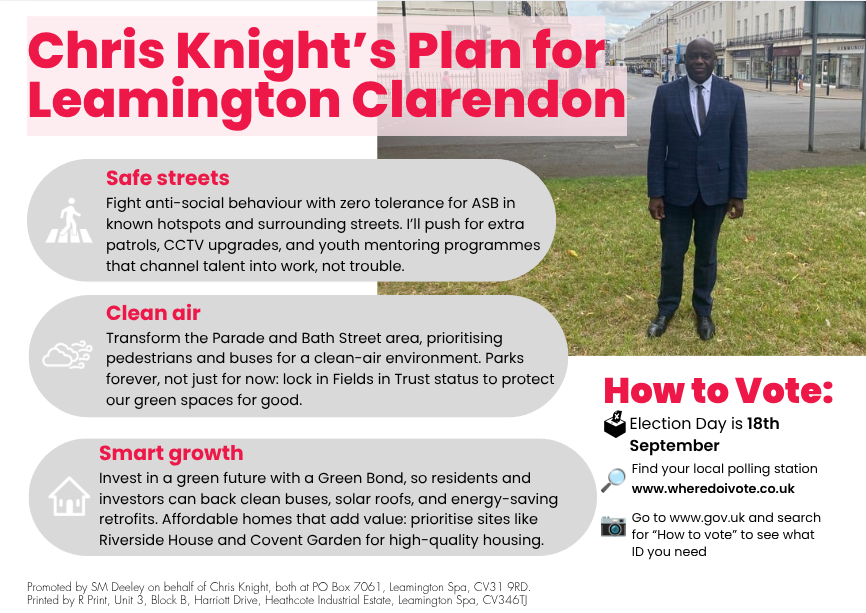
The leaflet was designed on Canva with input and approval of the Warwick CLP. It was designed to explicitly focus on hyperlocal Labour Party campaign promises in the Warwickshire area.
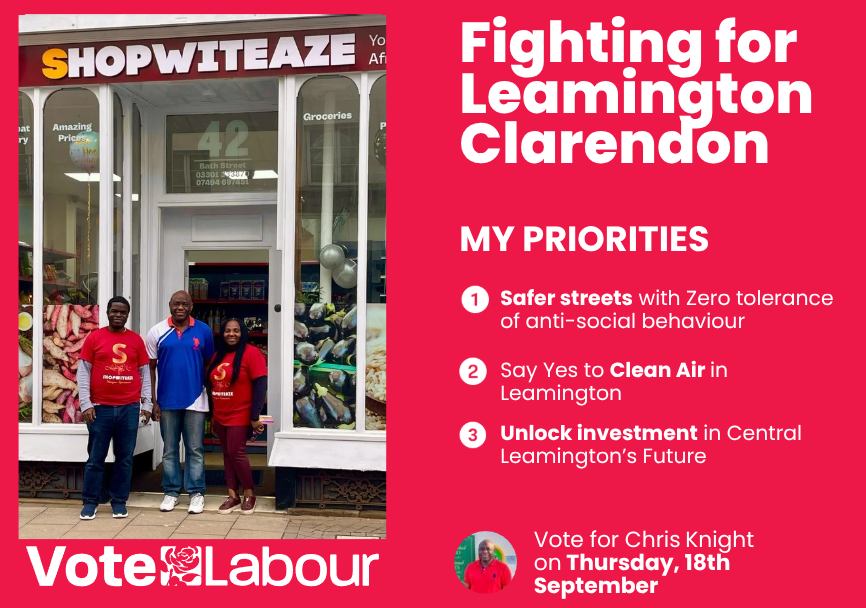
Left: Front side of the leaflet with a standard announcement of the candidate’s top 3 priorities. A picture of the candidate in a recognisably local location was selected.
Right: Over-side of the leaflet outlining the top 3 hyperlocal campaign promises and an additional picture of the candidate in a recognisably local area.
Analysis of Results
The post-election analysis, conducted using the digitized marked register, showed that the intervention did not influence turnout.
Key Data Points
- Treatment Group Turnout: 34.24%
- Control Group Turnout: 34.35%
- Statistical Significance (p-value): 0.978
- Odds Ratio: 0.995 (95% CI: 0.721 – 1.380)
The difference in turnout between the two groups was a negligible -0.1 percentage points. The high p-value (well above the standard 0.05 threshold) indicates that any minor variation was due to random chance rather than the intervention.
Conclusions and Recommendations
The results clearly indicate that the local-issue postcard intervention had no measurable effect on increasing voter turnout in this instance.
Recommendations
- Iterate on Creative Strategy: Since the “hyper-local” content did not move the needle, future tests should explore different messaging hooks (e.g., social pressure, national themes, or different visual formats).
- Increase Scale: To achieve the statistical power required for generalizable insights, future tests must reach the originally envisioned 3,000-household threshold across multiple geographies.