
It is well established that older people tend to vote conservative, and this holds strongly in the UK: from 2017, age has replaced class as the primary voting indicator, and the gap between the voting preferences of older and younger people continues to grow. In this Academic Series event, Dr Laura Serra joined us to explore the factors contributing to the so-called ‘Greying Gap’.
While in the past young adults would become more conservative as they grew older, recent years suggest this trend may be shifting. A Financial Times study found that in both the UK and the US, millennials are the first generation to become more left-wing as they age, rather than drifting rightward – deepening the generational divide rather than closing it.
Dr Serra walked us through her research on the possible explanations for this shift, organised around three key questions:
-
- Do young people today have different values than they used to?
-
- Are young adults staying ‘younger’ for longer nowadays?
-
- Are certain parties becoming better at mobilising certain age groups?
Her central argument is that no single explanation is sufficient. The generational gap is the product of all three forces acting together – and understanding each is essential for anyone hoping to influence the outcome.
Do Young People Have Different Values These Days?
Can this shift be explained by young people becoming more socially progressive? Are younger voters moving leftward in a way not seen in previous generations? One plausible factor is that millennials hold significantly more university degrees than older generations.
Drawing on studies tracking economic and social values across age groups over time, she finds a striking asymmetry. There are no meaningful age differences on economic values – attitudes such as “big business has too much power” or “there is one law for the rich and another for the poor” – but young people are significantly more socioculturally liberal than their elders on issues such as capital punishment or deference to traditional national values. A parallel analysis of educational attainment tells a similar story: higher education does not appear to shift economic attitudes, but is associated with more left-wing social views and a significantly greater likelihood of voting Labour. In this view, it seems plausible that the expansion of higher education across younger cohorts drives the shifts in political values and voting patterns.
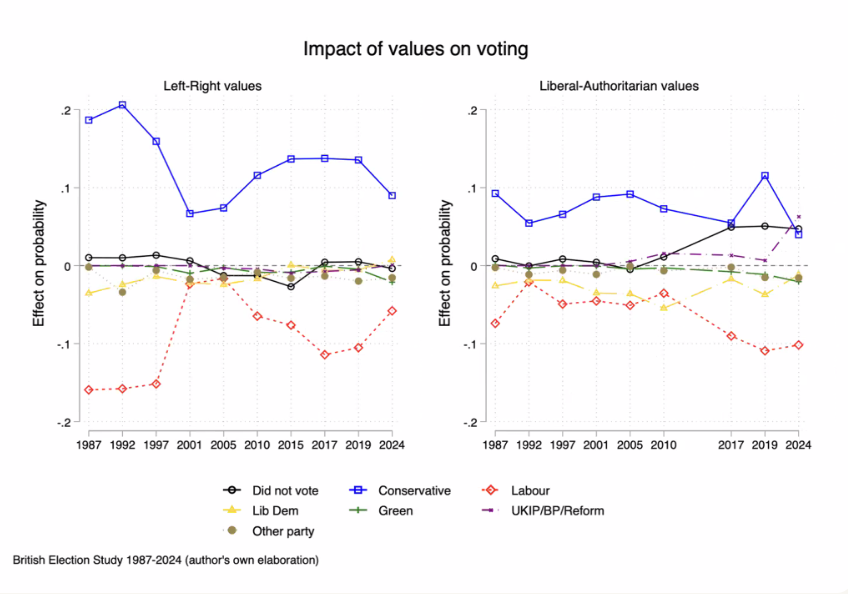
The complicating factor is that economic values have historically been the strongest predictor of party choice. However, in recent elections voters have struggled to differentiate between parties on economic policy – and as we have seen, there is no significant generational divide on economic attitudes anyway. Dr Serra’s conclusion is that, in the absence of clear economic differentiation, voters increasingly default to social values as their signal for who to support. The impact of values on voting has risen for young and old alike in recent years.
Values and education both matter, then, but neither is sufficient on its own to fully explain the gap.
Are young adults staying ‘younger’ for longer?
A second explanation shifts the framing: rather than young people becoming more left-wing, perhaps they are simply staying younger, and therefore left-wing, for longer than previous generations did. In many ways, the traditional path to ‘adulthood’ – getting a job, getting married, and moving out of your parents house, has been stunted for millennials; despite being the best-educated generation in history, millennials are considerably less wealthy, less likely to be in secure employment, and less likely to be married or to own a home than previous generations at the same age. If these milestones have historically driven a shift toward conservative voting, their absence could plausibly explain why millennials are not following the expected political trajectory.
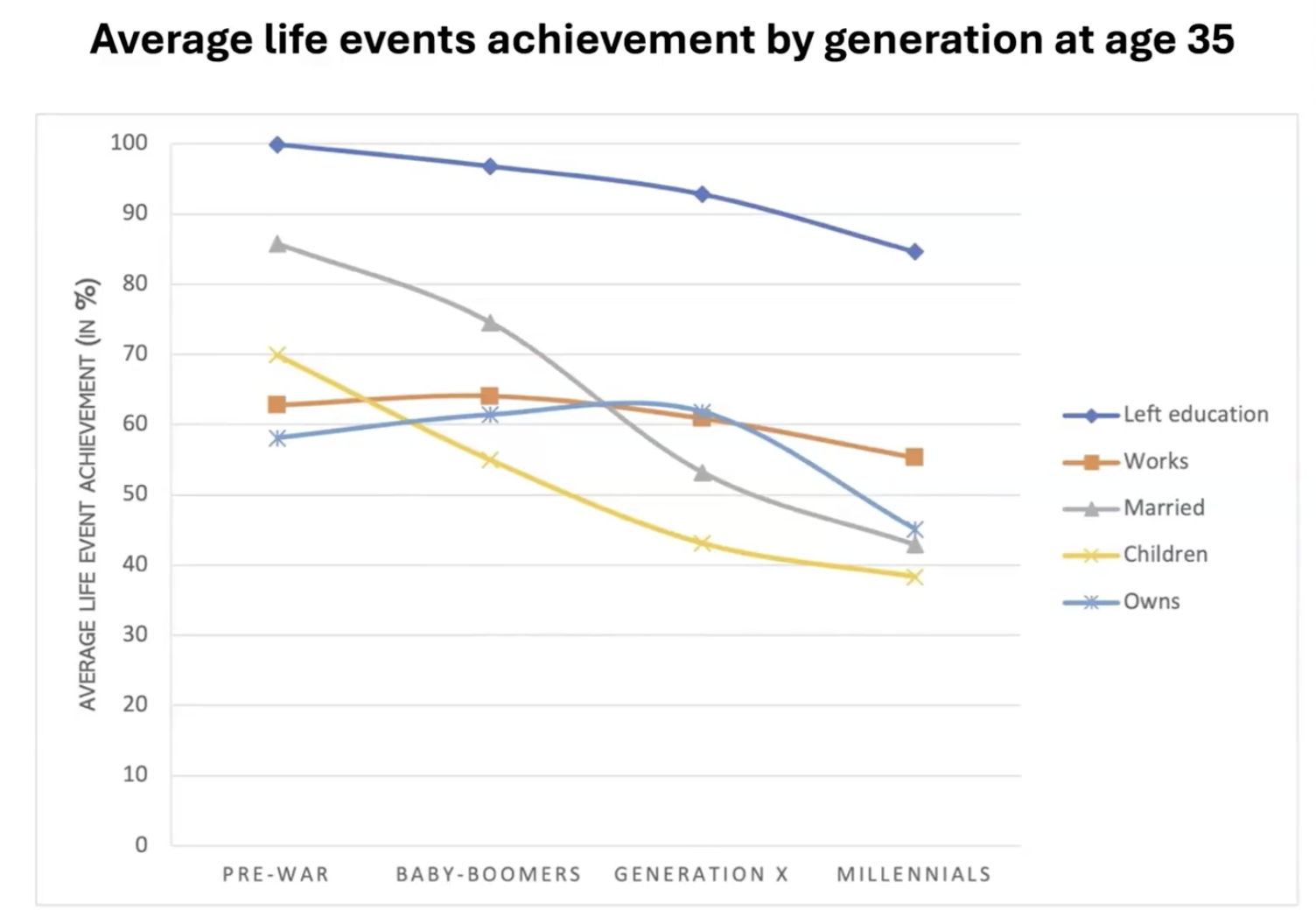
The evidence supports this. In the US, a ‘marriage gap’ has been identified whereby married women tend to be significantly more right-wing than their unmarried peers. Closer to home, Dr Serra’s research finds that millennials who do achieve these milestones are considerably more conservative than those who haven’t: the higher an individual scores on a ‘maturation index’ (an aggregation of the achievement of these life goals), the more likely they are to vote conservative. The political gap between young people may therefore be as much about economic circumstance as it is about values.
Are parties becoming better at mobilising certain groups?
Politics does not happen in a vacuum. Party strategy shapes which issues gain salience and which voters feel represented – so it is worth asking whether the generational divide is partly a product of deliberate political action.
In recent years, the Conservatives have developed a poor reputation among younger voters, while Labour has invested heavily in engaging the youth vote. To test the effect of party messaging directly, Dr Serras conducted a survey experiment in 2022, presenting a representative sample of British voters with two fictional candidates – one Labour, one Conservative – each delivering different messages drawn from the real Labour party manifesto.
The results were striking. Labour-style appeals had a positive effect on young voters across almost every policy area tested (the sole exception, on trans rights, was not statistically significant). Crucially, none of the appeals had a negative effect on older voters – suggesting that Labour-friendly messaging does not trigger a backlash among the groups already inclined to vote Conservative. Even more significantly, a Conservative candidate making left-wing appeals was able to close the gap with young voters. Parties can win on policy appeal alone, regardless of their brand. The charts below show support levels for the fictional candidates per topic of the appeal.
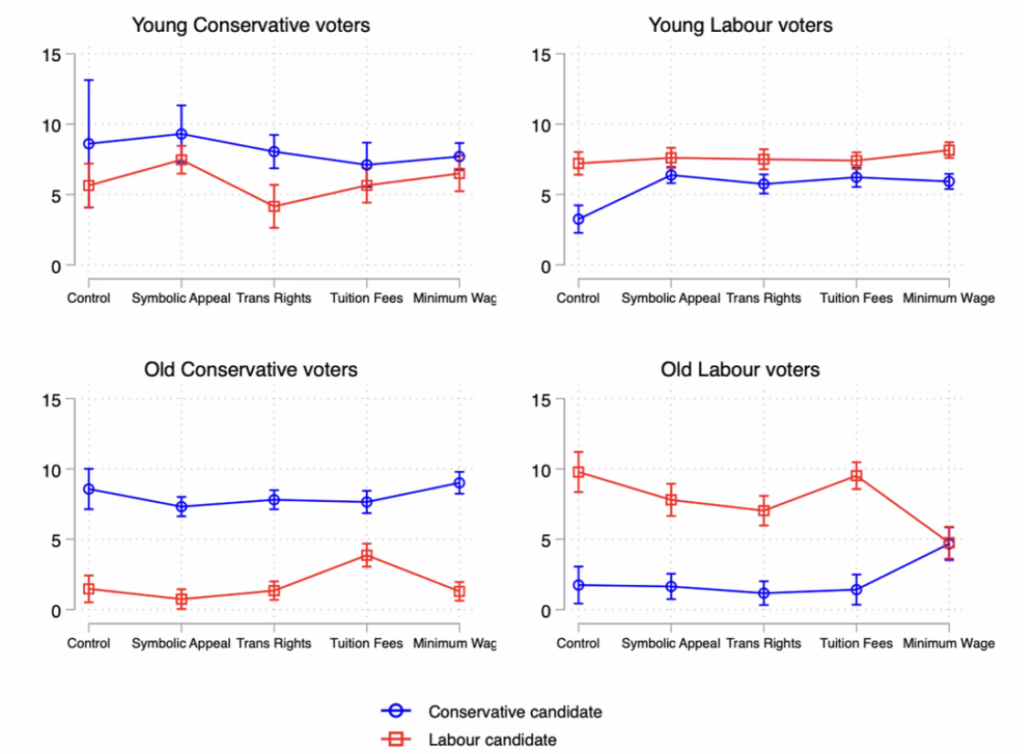
We see that while young people consistently skew Labour, Conservative candidates making youth friendly appeals can close the gap, and, crucially, this doesn’t appear to trigger a backlash across older voters.
What lies ahead, and what can campaigners take away?
Taken together, Dr Serra’s findings point toward a generational gap that is structural rather than incidental – and therefore unlikely to self-correct. Young people hold genuinely different social values; the life milestones that have historically moderated those values are being delayed by economic conditions that show no sign of reversing; and party strategies are reinforcing rather than bridging the divide.
Looking ahead, there is emerging evidence that the axis of this divide may shift from age to gender, with young women leaning increasingly left and young men trending rightward. For now, however, that gender gap is growing slowly.
For progressive campaigners, the practical implications are clear. Young voters are not a lost cause – Dr Serra’s experiment demonstrates that they can be persuaded by concrete policy appeals, and that making those appeals need not alienate older voters in the process. Given that generational change is driven from the younger cohorts upward, mobilising and enfranchising young voters is not merely symbolic: it is where long-term political realignment begins.